
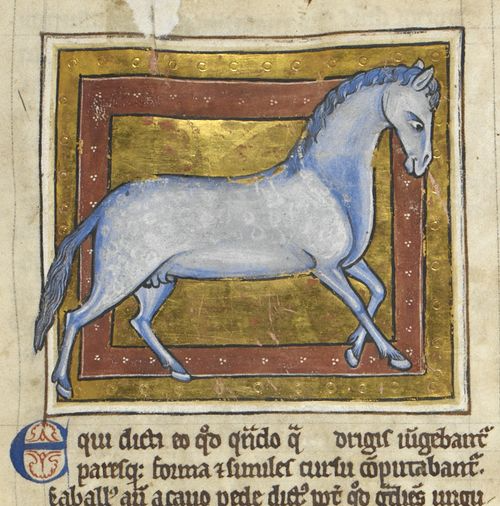
The horse, the mule and the donkey were the key animals in medieval society. Used for transportation, warfare, agricultural services, for hunting, parades, sports and recreation, they were also vehicles of status and among the human’s closest companions. If we want to understand medieval history, we need to have at least basic knowledge of horses and horsemanship in the medieval world.
Unit 1, Part 1
Introduction: why the horse is more and less than a machine
In our technology driven world, equids are often presented as living machines. Our reliance on gadgets and technologies is such that we are gradually losing sight of the horse as a being and a partner. Even the substitution of cycling for equestrian events in recent Olympic Games shows the depth to which our society misunderstands the value of the horse as a partner endowed with agency, which can help or hinder the humans who want to harness horsepower to their own ends. The evidence of medieval practice shows us how, centuries before the emergence of animal rights, there was appreciation of the fundamental needs of equids, which can be used as an example of good practice today.
Unit 1, Part 2
Horses as status signifiers: the working and the elite equids
In the Middle Ages, people were often judged on the mode of transportation they employed. In this unit, we will look at the significance of riding, driving, and walking practices. With sources ranging from Middle English and French romances to Arabic poetry and Slavic hagiography, the implications for using a mule or a donkey, a palfrey or a destrier, a stallion or a mare would have concerned the status, health, and even moral character of the rider.
Unit 2, Part 1
Dirty, smelly and dangerous? The practicalities of premodern horsemanship
Employ the evidence of literary sources, hippiatric treatises, and the archaeological record, combined with insights from modern veterinary science and animal psychology to provide a comprehensive view of the daily equestrian activities in the premodern world. What did medieval horses eat? Where and how were they kept? How were they trained? Did they have adequate health care provisions?
Unit 2, Part 2
Horse tack across ages and societies
The basic items of horse tack have changed little over the centuries: we still recognize horseshoes, bits, and stirrups. Yet much equestrian equipment being lost in the archaeological record is because it is perishable, recyclable, or both (such as the saddle), so the exact form and function of many of these items remains a mystery. This unit will study the practical and symbolic aspects of riding and driving equipment and its evolution in medieval Europe and Asia.
Unit 3, Part 1
Fantastic Equids
Unicorns, centaurs, water horses and winged equids were as real to medieval people as donkeys and mules. In this unit, we will hear the astonishing stories behind these fantastic equids, enjoy the images, and study the continuities and discrepancies in their representations across centuries and cultures.
Unit 3, Part 2
Horses and the supernatural world
Continuing with the themes of the imaginary and the exotic, this unit will look at the connection between equids and the supernatural world, with horses acting as prophets and psychopomps in pre-Christian cultures, but also as vehicles of divine will in Christian narratives. Additionally, we will look at the relationship between horses and other equids with saints and epic heroes.
Unit 4
An All-Male Affair? Gendering medieval horsemanship
From Joan of Arc and the Wife of Bath, through Byzantine empresses and Princess Olga, to Mulan in China, in medieval Europe and Asia, both men and women had regular opportunities for riding, with social standing and access to money rather than gender being key factors. In this unit, we will deconstruct a few myths about medieval horsemanship as an all-male affair.
Epilogue, Part 1
Tracing premodern horsemanship in today's sports
We explore the medieval and earlier precursors of such sports as equestrian vaulting and artistic gymnastics, racing, hunting, polo, and dressage, as well as such traditional and revived sports as mounted archery, mounted fighting (rossfechten), and jousting.
Epilogue, Part 2
Medieval horses in modern culture
We conclude with the representation of the medieval horse in modern art, cinema, and popular culture. Living on in films and cartoons, on paper and canvas, in stone and metal, as well as in children's toys and computer games, the medieval equid is still with us. Some of these interpretations perpetuate common myths about the Middle Ages and its relationship with the natural world, some use the equid as little more than a prop (equestrian statues), while others endow medieval equids with voice and agency. Using knowledge about medieval horsemanship gained in previous units, we will critically assess a selection of modern images of the medieval equid.
Meet Your Instructor

Anastasija Ropa
Anastasija Ropa, PhD, is lead researcher at the Latvian Academy of Sport Education as well as equine historian, horse trainer and owner. She co-edits the academic book series Rewriting Equestrian History and Cheiron: The International Journal of Equine and Equestrian History and has published numerous studies on the history of horses and horsemanship, including a monograph Practical Horsemanship in Medieval Arthurian Romance (2019) and co-edited volumes, including Echoing Hooves: Studies on Horses and Their Effects on Medieval Societies (Brill, 2022), Historical Practices in Horsemanship and Equestrian Sports (Trivent, 2022) and others. Her most recent book, The Medieval Horse (Reaktion, 2025), introduces the subject to the general public. The forthcoming Wild Horses and Their Relatives in the Middle Ages (Bloomsbury, 2026) explores the world of wild, feral and free-living equids and their place in medieval society.